Driveways & Concrete
Residential driveways, parking aprons, garage approaches and the flat concrete around a building. Surface cleaners cover open slabs evenly so the finish stays consistent, and edges, joints and corners are worked by hand.
Professional pressure washing for residential and commercial properties across Seattle: driveways, concrete, sidewalks and walkways, patios, entrances and steps, storefronts, parking areas and other durable exterior surfaces. The method and the pressure are matched to the surface after we have looked at it, and the schedule is built around how the property is actually used.
Locally owned and family-operated · Free written quotes · Mon-Sat: 7 AM - 7 PM
Exterior concrete darkens slowly. Dirt, traffic residue, moss and algae, spills and weather staining accumulate over months until a driveway, front path, entrance or walkway looks neglected, and by then nobody can remember what it used to look like.
We assess the surface, the buildup and the access first, then clean with an approach suited to that specific area, scheduled so a home is not disrupted and a business keeps its entrances and service routes usable.
Cleaning From The Heart LLC provides professional pressure washing and exterior hard-surface cleaning throughout Seattle, for homeowners, business owners and property managers alike. The work covers the exterior surfaces people actually use: driveways and concrete, sidewalks, front paths and walkways, patios and paver areas, entry pads, porches and exterior steps, storefront frontage, courtyards and shared outdoor areas, parking structure floors and ramps, loading docks and service entrances, and the waste-enclosure pads behind a building.
On the residential side, most calls are about a driveway, a front path or a patio that has quietly gone green or grey over a wet season, often before listing a house or ahead of the summer. On the commercial side, they come from property managers, facility managers, building owners and business owners who have watched a surface get gradually worse and want it dealt with properly rather than hosed down. Both are normal work here, and both are quoted the same way.
Some of it is a single cleanup on a property that has gone years without one. Some of it is a recurring schedule for driveways, entrances and walkways that will not stay clean on their own. Every quote follows a look at the actual surfaces, because material, condition and the type of buildup change the job more than square footage does.
If you have been searching for power washing rather than pressure washing, this is the same service. The two terms are used interchangeably in Seattle, and what matters far more than the label is that the pressure, the water and any pre-treatment are chosen to suit the surface in front of us.
Exterior work is often quoted alongside other services when a property is being handled in one visit, whether that is residential cleaning and residential window cleaning at a house, or commercial cleaning and commercial window cleaning across a business or managed property.
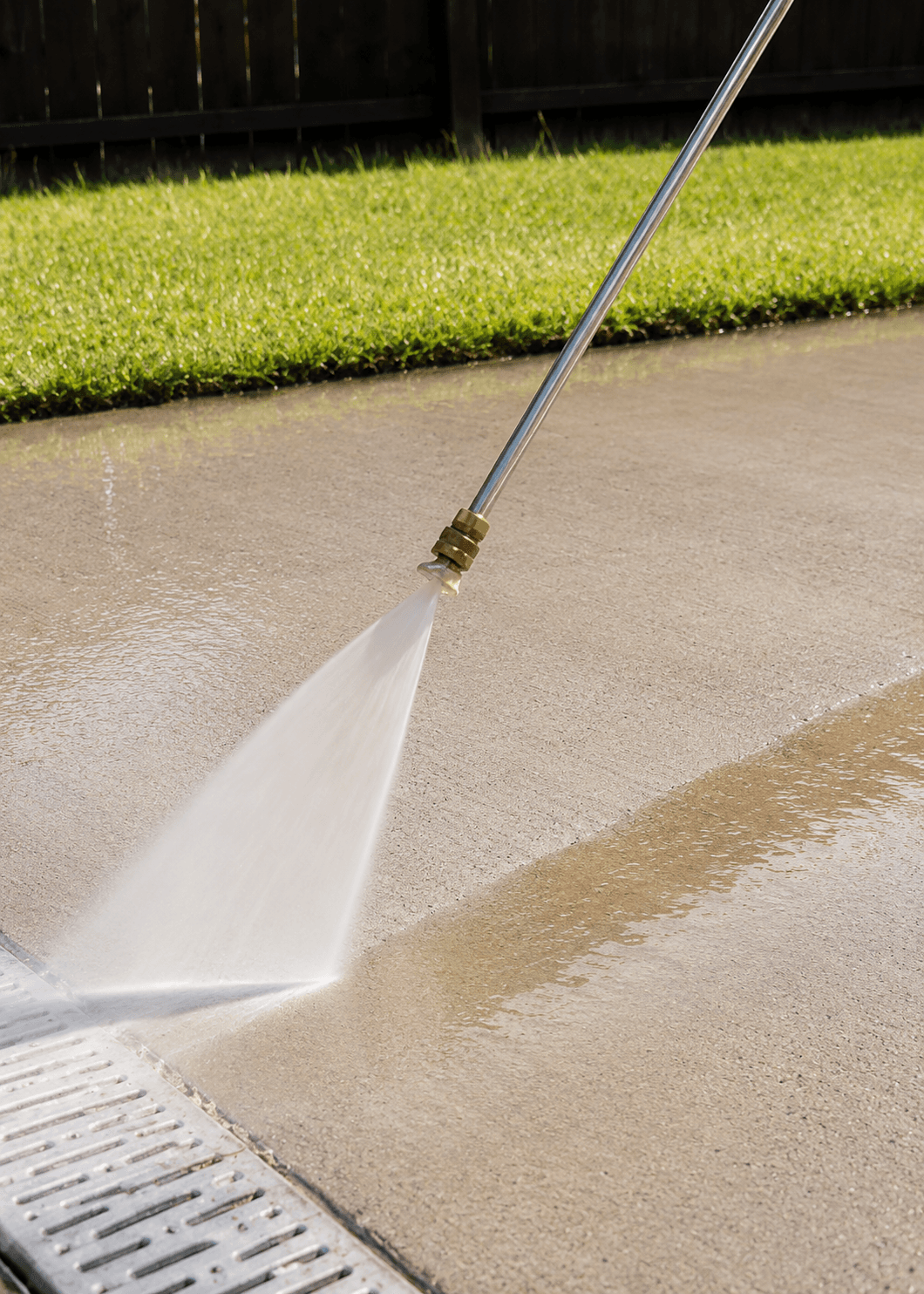
The durable exterior hard surfaces at a house or a business: what people walk on, what vehicles drive over, and the areas out of sight that nobody looks at until they become a problem.
Residential driveways, parking aprons, garage approaches and the flat concrete around a building. Surface cleaners cover open slabs evenly so the finish stays consistent, and edges, joints and corners are worked by hand.
Front paths, side returns, public sidewalk frontage, pedestrian routes between buildings and shared walkways through a property. Constant foot traffic, permanent weather exposure, and the first surface anyone stands on.
Concrete and paver patios, flagstone areas, courtyards, seating areas and breezeways. Shaded corners on these hold organic growth longest, which is why they are the most common residential request here.
Entry pads, exterior stairs and landings, porch concrete, thresholds and ramp approaches. Small areas that take far more traffic per square foot than anything around them, so they show wear first.
The concrete directly outside a shop, restaurant or office entrance, plus the frontage below display glass and any outdoor seating or queue space beside the door.
Garage floors, drive lanes, ramps, stair and elevator approaches, and selected surfaces in open parking areas. Enclosed structures need drainage and containment planned before anyone starts.
Dock aprons, delivery bays, service entrances, back-of-building concrete and the dumpster pads and waste-enclosure floors behind them. Usually the dirtiest area on a property and the least often cleaned.
Ground-level exterior wall surfaces, column bases, planter walls and hard landscaping. Brick, masonry, painted finishes and older mortar are assessed first, because material and condition decide whether pressure is appropriate at all.
Sound concrete tolerates a great deal. Aged brick, soft or failing mortar, painted finishes, some tile and anything already cracking or spalling do not, and forcing them only causes damage. Those surfaces are assessed on site, cleaned at a reduced pressure where that is appropriate, and left alone where it is not. You will be told which category a surface falls into before the quote is agreed.
This service is focused on durable exterior hard surfaces at ground level. Roof washing is not something we offer, and timber decking, fencing and delicate cladding are handled case by case after an assessment rather than assumed to be suitable. If a surface falls outside what we do, we will say so plainly instead of taking the job on.
Exterior surfaces rarely get dirty in one identifiable event. They collect several kinds of buildup at once, and each one responds differently: some lifts with water and pressure alone, some needs pre-treatment and dwell time, and some has already changed the colour of the concrete permanently.
Knowing which is which before starting is most of the job. It decides the method, the time an area takes, and what we tell you to expect.
Results vary with the surface, its age and the type of staining. Concrete is porous, and something that has been soaking into it for years, oil, rust, tannin, has stained the material rather than sat on top of it. Cleaning improves those areas; it does not reset them. We assess the buildup before agreeing an approach and tell you plainly which parts will come up and which will only get better.
Airborne dust, tracked-in soil and road grit that dulls concrete evenly until nobody notices how dark it has gone.
The green and black film that forms on damp, shaded hard surfaces, and the moss that establishes in joints and low spots.
Compacted gum, scuffing and the dark traffic lanes that develop on a front path or a walkway where everyone walks the same line.
Dark tannin staining where leaves have broken down on concrete, and the silt that washes onto paths from beds, borders and lawns.
Drips on a driveway or in a parking area, grease around dock doors, and kitchen exhaust residue that settles on nearby ground surfaces.
Rubber deposits, brake dust and road film left on driveways, garage floors, drive lanes and dock aprons by daily vehicle movement.
Rain-carried dirt, downspout runoff trails and the streaking that gathers on concrete below gutters, roof edges and overhangs.
Spills around outdoor seating and back doors, plus the leakage on dumpster pads and enclosure floors behind restaurants and retail.
Seattle does not get dramatic rainfall so much as persistent rainfall. Surfaces stay damp for long stretches through autumn, winter and spring, and damp concrete is where moss and algae establish themselves. It is the single most common reason a property here books this service, whether that is a house with a shaded front path or an office block with a north-facing courtyard.
Where it shows first is predictable. North-facing driveways and walkways that never catch direct sun. Concrete under a canopy, an overhang or a stairwell. Paths beside planting beds, under trees, or along a fence line. Low spots where water sits after it stops raining. Those areas go green, then dark, and start looking neglected long before the open, sunlit parts of the same property do.
Wet weather also carries dirt around. Runoff traces dark lines below downspouts and roof edges, leaves break down on hard surfaces and leave tannin marks, and silt washes across walkways from planting beds and construction nearby. None of it is remarkable on its own, but a season of it changes how a building reads from the street.
The practical consequence is that exterior cleaning here is a cycle rather than a one-time fix, and that timing matters. Work is planned around dry-enough windows and around when the property can spare the area. For most homes that lands as a spring clean once the worst of the wet season has passed; for commercial sites it usually becomes a standing schedule rather than an emergency call.
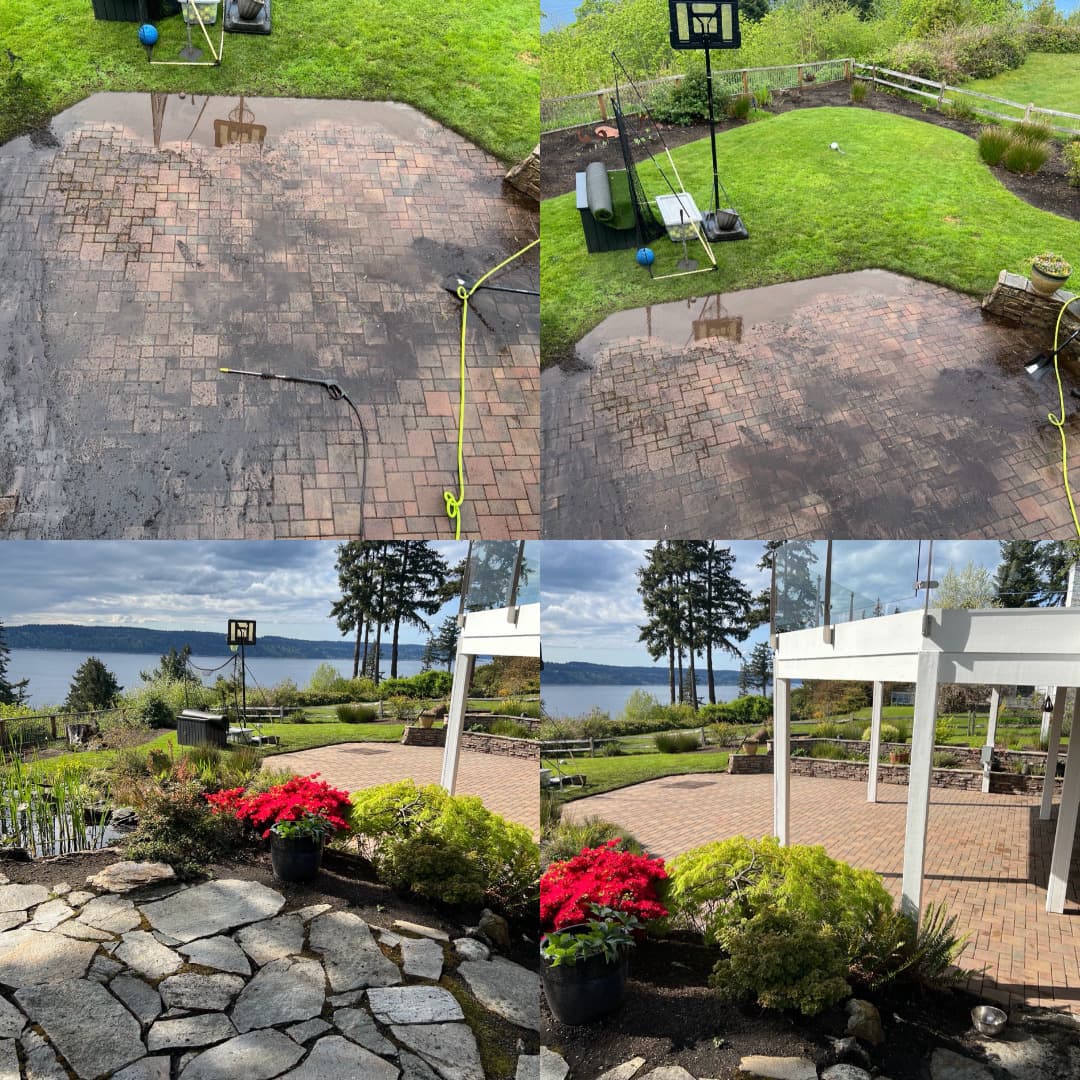
Residential pressure washing is the fastest visible improvement most homeowners can make to the outside of a house, and it is usually the cheapest. A driveway, a front path and a patio are the three surfaces a visitor crosses before they reach the door, and all three darken so gradually that the change is invisible until a cleaned section sits next to an uncleaned one.
We clean the durable exterior hard surfaces at a property: driveways and parking aprons, front paths and side returns, sidewalk frontage, concrete and paver patios, entry steps, landings and porches, and courtyards. The work is the same care we bring to a commercial site, scaled to a house and scheduled so it takes a morning rather than a weekend.
What matters more than raw power is knowing what a surface can take. A sound concrete driveway, a sand-jointed paver patio, older brick edging and a painted set of steps are four different jobs, and treating them as one is how exteriors get damaged. Every surface is assessed before the method and the pressure are set, and anything we would not recommend cleaning this way is flagged at the quote.
Roof washing is not a service we offer, and timber decking, fencing and delicate cladding are assessed individually rather than assumed to suit high pressure.
Concrete darkens slowly and evenly, so the change never registers day to day. The line where a cleaned section meets an uncleaned one is usually the first time a homeowner sees how far it had gone.
Exterior hard surfaces photograph badly when they are green or grey, and the driveway and front path are in almost every listing photo. This is commonly booked in the week before photography or a first viewing.
After a Seattle autumn and winter, shaded paths and north-facing patios carry a season of organic growth. A single spring clean resets them, and shaded areas often move to a repeating visit.
Pavers with sand joints, older brick, soft mortar and painted steps all need a different approach from a sound concrete slab. Which category a surface falls into is settled at the assessment, before any work is quoted.
Exterior work at a house is often booked with residential window cleaning or a move-in / move-out clean, so the inside and the outside of the property are handled in the same visit.
A driveway is the largest single piece of concrete on most properties and the one that takes the most punishment. It carries vehicles, collects everything that washes down off the roof and the garden, and sits exposed to the weather year round. It is also the first thing anyone sees from the street, which is why driveway cleaning is the most requested residential job on this page.
Driveways rarely have one problem. A typical Seattle driveway carries a layer of general grime, moss and algae in the joints and along the shaded edge, tire marks where the car turns, tannin staining under a tree, and often an oil mark or two. Each of those responds differently, so an even pass with a surface cleaner is only half the work. Joints, control gaps, edges and the apron at the pavement are worked separately, and heavier organic buildup is pre-treated and given time to break down before it is washed off.
What we typically find on a driveway:
Road grit, airborne dust and soil washed down from beds and lawns. This is the layer that dulls a driveway uniformly, and it is also the one that lifts most completely.
The green film and dark patches that establish on damp concrete, plus moss rooted into control joints, expansion gaps and the low spots where water sits after rain.
Rubber deposits and brake dust where cars turn and park, and the darker wheel tracks that develop along the line vehicles use every day.
Drips under a parking spot. Recent marks sitting on the surface usually improve considerably. Oil that has soaked into porous concrete over years has stained the slab itself, and cleaning improves those areas rather than erasing them.
Dark staining left where leaves have sat and broken down on the concrete, common under trees and along the edges of a driveway.
The dirt lines that form where water runs off a roof edge, a downspout or a slope and crosses the driveway on the same path every time it rains.
We do not promise complete oil stain removal, and you should be wary of anyone who does. Concrete is porous. A fresh drip sitting on the surface usually lifts. Oil that has been soaking into the slab for years has stained the material itself, and cleaning will improve how it looks without erasing it. How much comes up depends on the stain, its age and the surface, and we will give you a realistic view of your driveway before you agree to anything.
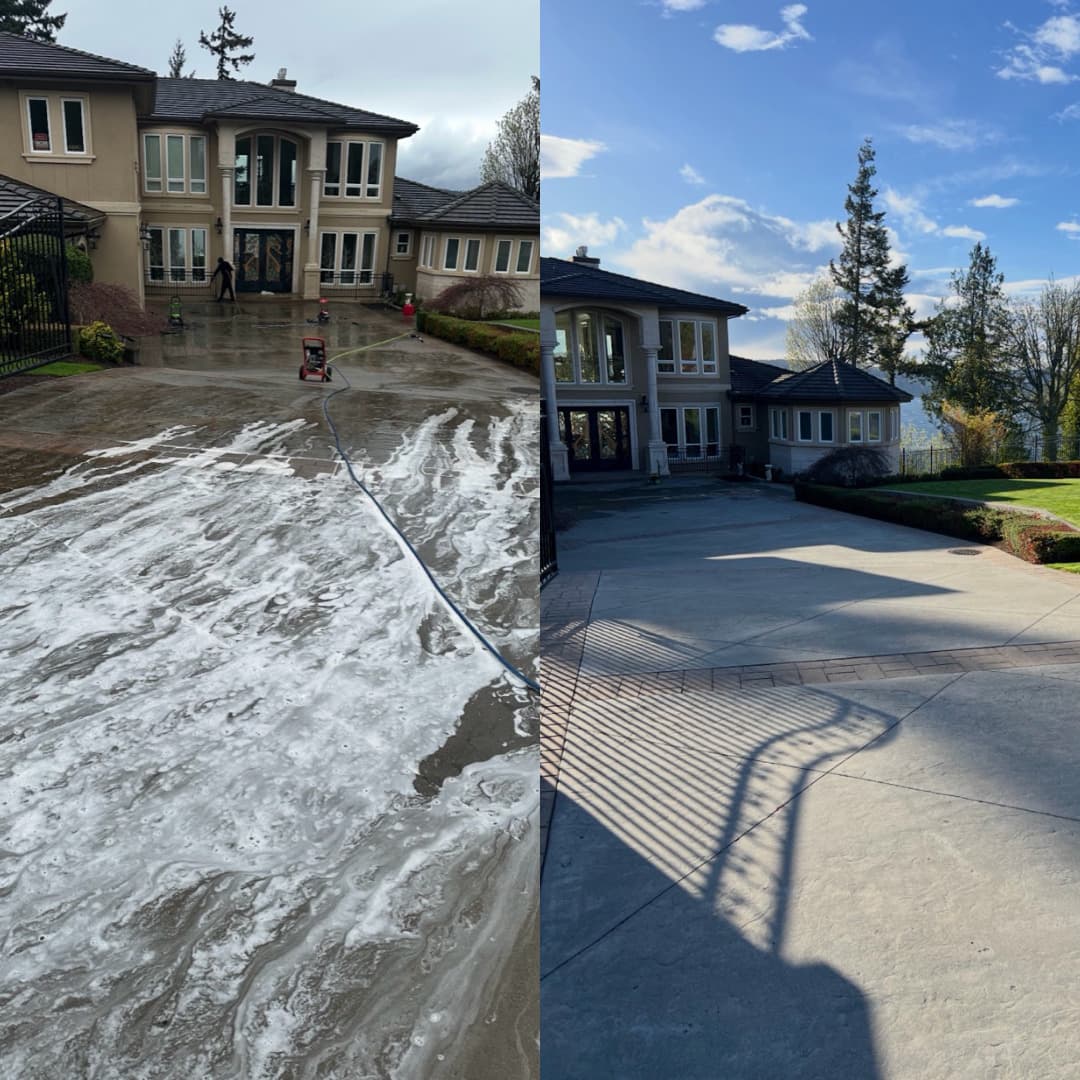
Concrete is the default surface at almost every property, residential and commercial alike, and it hides its condition well. Because it darkens uniformly and slowly, a slab can lose most of its original tone before anyone registers that it has changed. The contrast at the edge of a cleaned section is usually what makes the point.
It is also porous, which is the fact that governs this work. Water, oil, tannin and organic growth all move into the surface rather than resting on it, so cleaning concrete properly means lifting what has penetrated the top layer, not just rinsing across the top of it. Open areas are covered with a surface cleaner for an even result, edges, corners and joints are worked separately, and heavier buildup gets pre-treated and given time to break down before it is washed.
Where a slab is cracking, spalling or has a failing sealer, we will say so during the assessment. Pushing pressure into damaged concrete makes it worse rather than better, and a surface already breaking down needs a repair conversation, not a washing one.
Sidewalks take the most concentrated foot traffic on a property and get the least maintenance attention, because sweeping them is easy and nobody looks closely at what sweeping leaves behind. Over a year or two a walkway develops a dark central lane where everyone walks, and the difference between that lane and the untrodden edges is the clearest sign a surface is overdue.
It is the same job at a house and at a business, only the scale changes. A front path and the sidewalk frontage at the kerb wear exactly the way a shared campus walkway does, and both are cleaned here. This is presentation work more than anything else: a visitor forms an impression on the approach, before the door, and shared walkways across an apartment complex or office campus are the part of a property residents and tenants see every single day. We clean these areas so they look maintained. We do not claim that cleaning makes a walkway safe or prevents accidents, which depends on the surface, the weather and the property's own maintenance.
Public-facing sidewalks are usually cleaned early morning or after hours, with the section cordoned while it is being worked and rinsed, so pedestrian routes are disrupted as little as possible.
Patios sit still. Unlike a driveway or a path, nothing crosses them for months at a time in the wet part of the year, so organic growth settles in undisturbed and a surface that looked fine in September can be green by March. Shaded patios, north-facing seating areas and anything under a tree or an overhang show it first.
Patio cleaning is worth doing before the season rather than during it. A patio that has been washed and rinsed in spring is usable straight away, and the difference between a cleaned paver area and the state it was in is normally the most dramatic before-and-after on a residential property.
Outdoor hard surfaces are not interchangeable, though, and this is where surface assessment earns its place. Poured concrete, pavers with sand joints, flagstone, tile and timber all behave differently under pressure. We work out what a surface is and what condition it is in before deciding the method, and anything that should not be pressure washed is identified at the quote rather than discovered afterwards.
The most straightforward surface on this list. Sound concrete tolerates a surface cleaner well and cleans up evenly across a large area.
Cleaned with the joints in mind. Sand-filled joints can be disturbed by careless work, so pressure and angle are adjusted, and you will be told if joint sand is likely to need topping up afterwards.
Seating areas, breezeways and the hard surfaces between buildings on condominium, apartment and office properties, where shaded corners hold growth longest.
The exterior stairs, kerbs, low walls and hard edging around a patio, worked by hand so the finish matches the open area rather than stopping at it.
Softwood decking is easy to damage with a pressure washer: too much force raises the grain, furs the timber and strips finish unevenly. We do not treat decking as a standard part of this service. If you have one, tell us and we will look at it, but we will only take it on where the condition of the timber makes it sensible.
Send the property type, the surfaces involved, roughly how much area, and when the work would need to happen. Photographs of the worst areas tell us more than a description does, and the quote comes back in writing with no obligation.
The other half of this service. Commercial pressure washing covers business frontage, facility exteriors and managed property, and it is a different job from cleaning a driveway — larger areas, live operations, and access that has to be planned.
Commercial power washing is regular work for us across Seattle for business owners, property managers, facility managers and building owners. The surfaces are the ones a property runs on: entrances and storefront concrete, public sidewalk frontage, shared walkways and courtyards, parking structures and drive lanes, dock aprons and service entrances, and the waste-enclosure pads at the back that nobody looks at until they smell.
What changes at commercial scale is not the cleaning so much as everything around it. A business cannot close its entrance for a day, a garage cannot empty every level at once, and a dock cannot be out of use when trucks are booked. So the work is staged, cordoned and scheduled: early mornings, evenings, weekends and quiet trading periods, with areas released back into use section by section as they are finished.
For managed portfolios, scope can be standardised so each property is cleaned to the same specification, and exterior work can run on the same calendar as an existing commercial cleaning schedule, through one point of contact. The sections below cover the three commercial areas we are asked about most.
The highest-return area on any business frontage, and a short enough job to fit before opening.
Floors, drive lanes, ramps and approaches, staged level by level so the structure stays open.
Dock aprons, delivery bays, back-of-building concrete and dumpster pads, planned around delivery windows.
One specification applied across multiple sites, coordinated with on-site staff and existing schedules.
An entrance is a small area doing a disproportionate amount of work. Everyone who visits crosses the same few square metres, so it accumulates buildup several times faster than the concrete twenty feet away, and it is the part of the property a customer is closest to.
For retail, restaurants and any business with walk-in trade, this is the highest-return area on the whole property to keep clean. It is also the easiest to schedule: entry concrete is a short job, so it can be done before opening without affecting a day's trading.
Frontage tends to be cleaned as a set. Concrete, entry steps and thresholds come first; if the glass is being cleaned in the same period, doing both together is what makes a storefront look deliberately maintained rather than partially done.
The two or three metres directly outside a door take more foot traffic per square foot than anything else on a property, and it shows first.
Ground surfaces below display windows collect splash marks, drips and street grit. Cleaning them the same week as the glass makes both look intentional rather than accidental.
Outdoor seating, waiting areas and queue space next to an entrance pick up drink rings, food residue and cigarette marks.
In a strip or centre, one dirty section drags down the whole run. Multi-unit frontage is usually cleaned in a single visit for that reason.
Parking structures collect a specific kind of dirt. Vehicles bring in road film, brake dust and rubber, tires lay marks down in the turning areas, and because most of a garage never sees rain or sun, none of it washes off or dries out. It compounds year after year, and the lower and older levels usually show it worst.
This matters more than a garage's status as a back-of-house area suggests. For an office building, apartment property or hotel, the garage is where tenants, staff and guests arrive, so it is the first impression the property actually makes, whatever the lobby looks like. Cleaning also makes level markings, bay lines and signage read clearly again.
Enclosed structures collect water rather than shed it. Where drains run, where water pools and how runoff is managed are settled before a machine is switched on.
Garages rarely close. Work is normally staged level by level or bay by bay, overnight or on weekends, so a section is emptied, cleaned and released while the rest of the structure stays in use.
Fresh drips usually lift. Oil that has soaked into porous concrete over years has stained it, and the honest answer is that cleaning will improve it rather than erase it.
Washing a structure is different work from keeping an open lot tidy. If what a property needs is routine litter, debris and perimeter upkeep between washes, that sits under parking lot and exterior maintenance.
The back of a commercial building takes the heaviest use on the property and gets cleaned the least. It is also where buildup starts causing problems rather than just looking bad.
Dock aprons take truck traffic, pallet jacks, dropped product and whatever the weather drags in behind it. Mud packs into the low spots along the dock face, grease works its way out from around the doors and equipment, and spills get run over until they are part of the surface. For warehouses, restaurants and distribution-side operations, this area is doing real work every day and shows it.
Timing is the constraint that shapes the job. Docks cannot be out of use when trucks are booked, so work is planned around delivery windows, generally early, late or at weekends, and staged bay by bay where a site cannot give up the whole dock at once.
Waste areas are part of the same run. Concrete pads under and around bins, enclosure floors and the surrounding hard surfaces collect leakage and residue that is usually the real source of a persistent smell behind a building, particularly at restaurants, retail centres and apartment properties.
This is surface cleaning, not sanitising or disinfection, and we describe it that way deliberately. Washing the pad lifts residue and buildup off the concrete, which reduces what the smell is coming from. It does not treat the bins themselves.
Different properties wear their exteriors out in different ways. These are the ones that book this service most, each linked to what we do for that sector.
Driveways, front paths, patios, porches and entry steps at single-family homes and townhomes across the Seattle area.
Residential cleaningShared walkways, breezeways, entry courtyards and garage levels, quoted for the association or the managing agent.
Property management cleaningExterior hard surfaces cleaned between tenancies, often alongside the interior turnover clean so the whole property is handled in one visit.
Move-in / move-out cleaningEntry plazas, walkways, exterior stairs and the concrete that every tenant and visitor crosses on the way in.
Office & commercial building cleaningEntry areas, shared shopping-centre walkways and the sidewalk frontage a customer judges before opening the door.
Retail store cleaningPatio and entry concrete, back-door service areas and dumpster surrounds, where spills and grease collect fastest.
Restaurant cleaningEntrances, covered walkways, courtyards and play-adjacent hard surfaces, cleaned in breaks and outside school hours.
School facility cleaningShared walkways, breezeways, entry courtyards, garage levels and waste-enclosure pads across managed residential properties.
Property management cleaningDock aprons, delivery bays, yard-adjacent concrete and the service routes that take the heaviest vehicle traffic.
Warehouse & industrial cleaningArrival areas, entry canopy concrete, guest walkways and service yards, scheduled around occupancy and check-in times.
Hospitality property cleaningEntry steps, accessible ramps and connecting paths, usually cleaned midweek so weekend services are unaffected.
Places of worship cleaningDisplay concrete, customer walkways and service-bay approaches, where oil marks and tire residue are constant.
Auto dealership cleaningProperty types beyond these are covered too, see all the industries we serve.
Pressure washing is not one setting applied everywhere. What actually gets decided on site is how much pressure a surface can take, what it needs beyond water, and what has to be protected while the work happens.
Poured concrete, pavers, brick, masonry, tile and painted surfaces each behave differently. Sound concrete tolerates a great deal; older brick, soft mortar and painted finishes do not.
Cracking, spalling, loose mortar, failing sealer or flaking paint change the answer. A surface already breaking down is not made better by force.
Loose surface dirt, embedded organic growth and oil that has soaked into the slab are three different problems. Pre-treatment and dwell time often matter more than raw pressure.
Nearby glass, signage, joinery, planting, parked vehicles, air intakes and pedestrian routes all shape how an area is worked and what gets protected first.
Water supply, where runoff goes and which drains it reaches are checked during the site visit. On enclosed or sloped sites this often sets the schedule.
Live traffic, deliveries, pedestrians and working hours decide when an area can be closed off, and closing it off properly is part of the job.
On stubborn organic buildup, letting a pre-treatment do its work usually achieves more than turning the machine up, and it does so without etching the surface, stripping mortar or driving water where it should not go. Some surfaces get cleaned at a deliberately lower pressure for that reason. Where a material or its condition means it should not be cleaned this way at all, that is a conversation we have at the assessment rather than a discovery you make afterwards.
A locally owned, family-operated company with 30+ years of hands-on experience across Seattle-area residential and commercial properties.
A driveway and front path at a house, and the frontage, walkways and service areas across a managed portfolio, are both normal work here. Scope is written against your property rather than a fixed package.
The surface is assessed before the pressure is set. Where a material or its condition makes aggressive cleaning a bad idea, you will hear that before the work rather than after it.
Early mornings, evenings, weekends and quiet trading periods. Areas are worked in sections so a walkway, dock or garage level is out of use for as short a time as possible.
A single cleanup before an event or inspection, or a repeating schedule that keeps entrances and high-traffic concrete from getting away from you.
Pressure washing can sit alongside house cleaning, window cleaning, commercial janitorial, floor care and junk removal under one point of contact instead of four.
If a stain has permanently discoloured concrete, or an area needs a different approach entirely, we say so at the quote stage. Nobody benefits from a surprise on the day.
Four steps from first call to finished surfaces, the same at a house as at a commercial site. Everything that affects the price or the schedule is settled before a date is held.
We look at the areas you want cleaned: surface material, condition, the type and depth of buildup, square footage, access, water supply and where runoff will go.
The approach, the areas included, the timing and anything we would advise against are set out in writing. Realistic expectations for stained areas are part of that conversation.
Areas are prepared and cordoned as needed, pre-treated where the buildup calls for it, then cleaned with the method and pressure matched to the surface, edges and corners included.
Cleaned areas are rinsed down, the site is left clear, and the work is reviewed against the agreed scope with you or your on-site contact.
Some properties need one thorough cleanup. Others need the entrances and walkways kept from sliding back, which is a different arrangement.
A single visit with a defined scope and end point.
A repeating cycle set against how the property is used.
We do not prescribe an interval before seeing a property, because the same schedule would be wasteful on one site and inadequate on another. A restaurant entrance and a quiet office courtyard sit at opposite ends of that range. After the assessment we will suggest a realistic cycle, and where a property already has a commercial cleaning schedule, exterior work is usually folded into the same calendar.
What determines how often:
Exterior surface cleaning at Seattle-area properties. Both of these show residential hard surfaces that had carried years of weather and organic buildup before the visit.
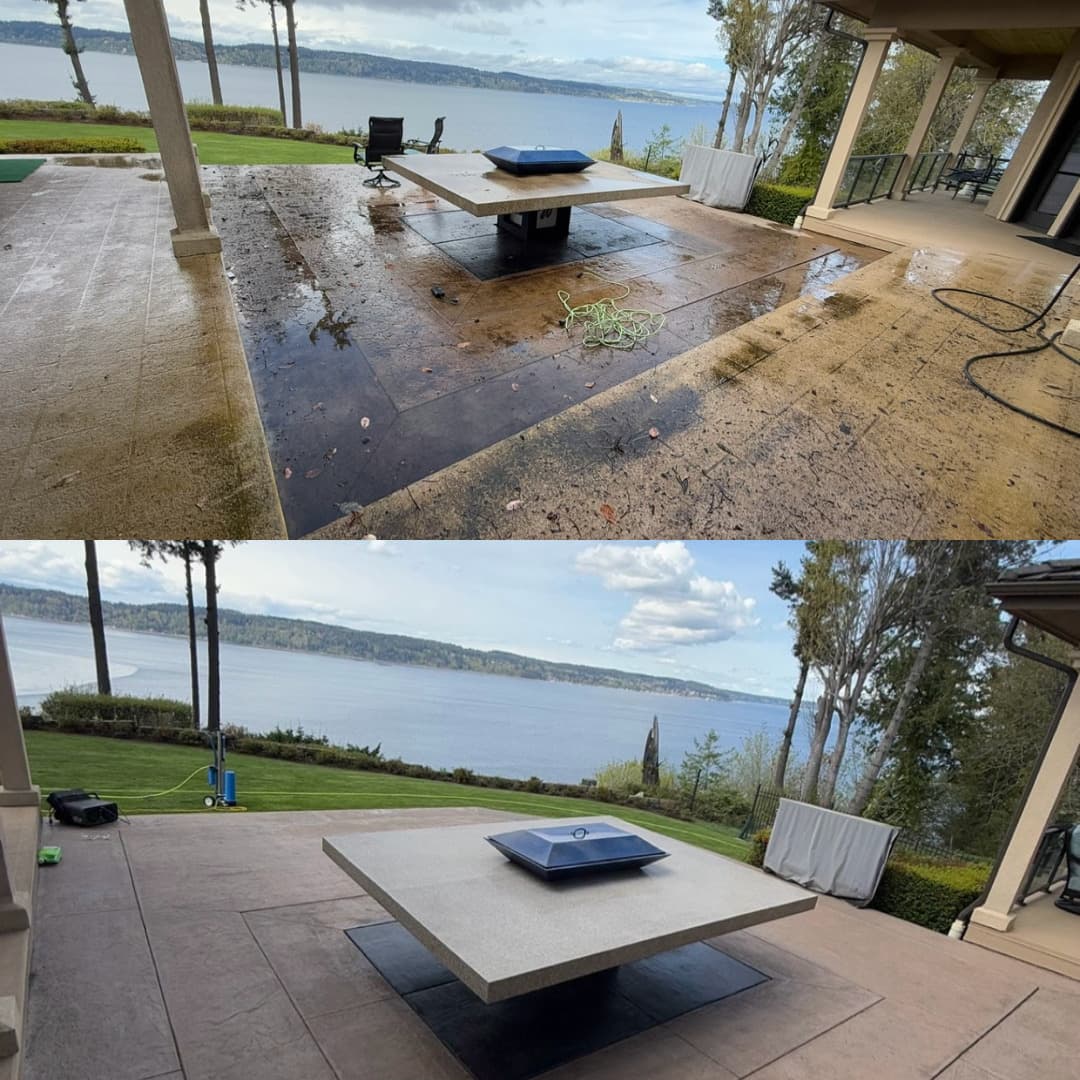
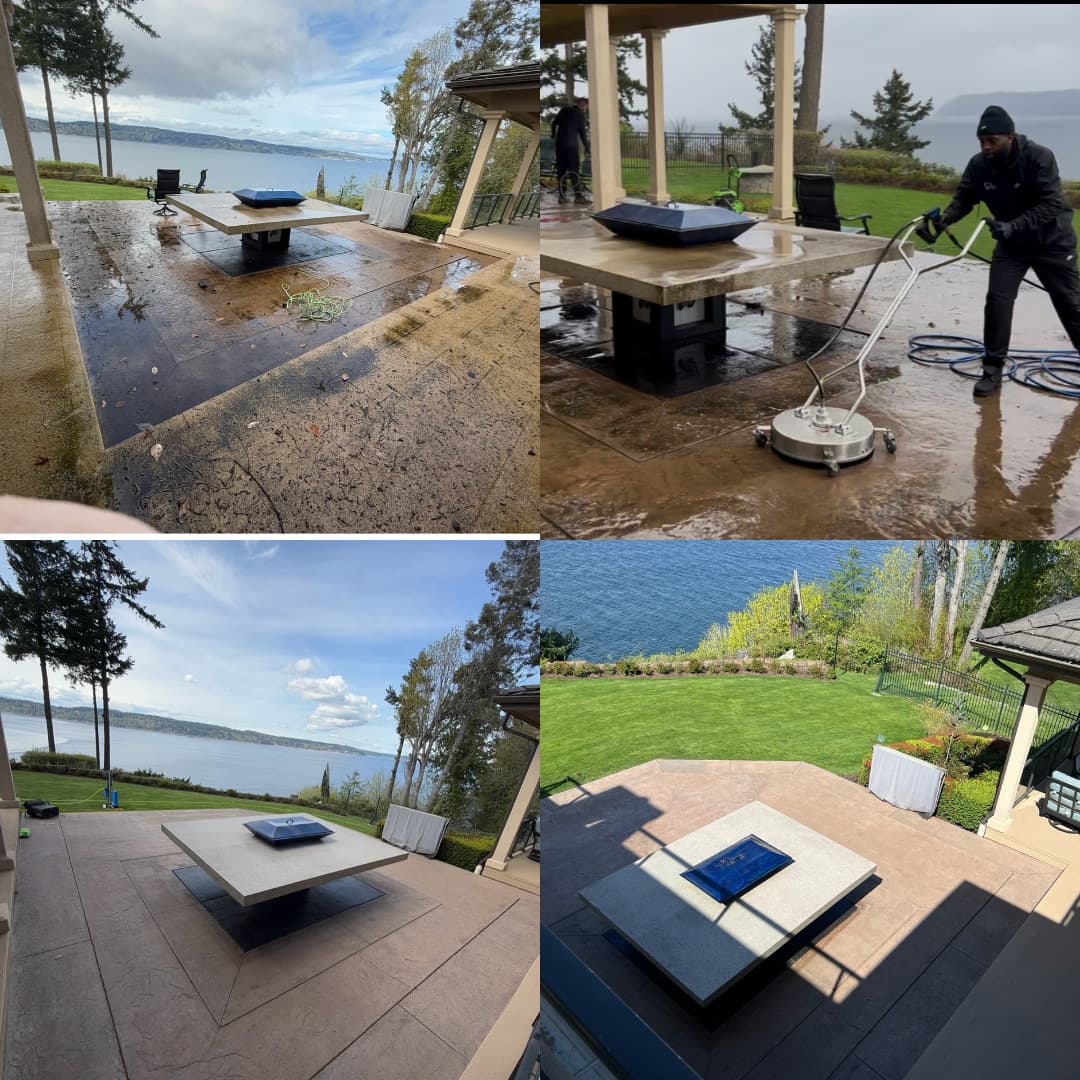
More exterior cleaning, floor care and window cleaning photos from properties across the Seattle area.
Seattle is where most of this work happens, and the surrounding cities below are served from the same schedule. Water access, drainage and parking all get confirmed when we quote, so if your property sits toward the edge of the areas listed, a quick call will settle whether we can cover it properly.
Serving Seattle, Renton, Bellevue, Kent, Everett & Surrounding Areas. Business hours Mon-Sat: 7 AM - 7 PM.
What homeowners, business owners and property managers ask most before booking exterior surface cleaning in Seattle.
Question about your own property?
Send the surfaces involved, roughly how much area and a photo of the worst of it, and we will tell you what is realistic.
Durable exterior hard surfaces at ground level: driveways, concrete sidewalks and walkways, front paths, patios and paver areas, entry pads, porches, exterior stairs, courtyards, concrete pads, parking structure floors and ramps, dock aprons and dumpster pads. Brick, masonry, older mortar and painted surfaces are assessed individually, because the material and its condition decide whether pressure washing is appropriate at all and at what pressure. If a surface should not be cleaned this way, we will tell you rather than take the risk.
Yes. Driveways, front paths and walkways, patios, porches, entry steps and other durable exterior hard surfaces at houses, townhomes and condominium properties are all regular work. Homeowners usually book it as a spring reset after a wet season, before listing a property, or when a shaded path has gone green. Quotes are free and given in writing after we have seen the surfaces involved.
Yes. Commercial exterior surface cleaning is regular work for us across Seattle and the surrounding cities, for business owners, property managers and facility managers. Typical jobs are entrances and storefront concrete, sidewalks and shared walkways, courtyards, parking structures, dock aprons and waste-enclosure pads. Work is quoted per property after we have seen the surfaces and the access.
Yes, and it is one of the most requested jobs on the residential side. A driveway collects road grit, tire marks and traffic residue at the same time as moss and algae establish in the joints and low spots, so it usually needs both an even pass with a surface cleaner and hand work along the edges and control joints. Sound concrete handles this well. Where a driveway is cracking, spalling or has a failing sealer, we will say so before quoting rather than force pressure into it.
It usually improves the surface considerably. Moss and algae grow on damp, shaded hard surfaces throughout the year here, and washing lifts the growth along with the organic film underneath it. Growth rooted into cracks and joints can leave marking behind, and shaded areas will start to regrow, which is why properties with north-facing or tree-covered walkways often move to a repeating schedule rather than a one-off clean.
Sometimes fully, often partially. Recent drips sitting on the surface generally come up. Oil that has soaked into porous concrete over months or years has stained the slab itself, and no amount of pressure changes that. We assess the staining first and give you a realistic expectation before quoting, rather than promising a result the surface cannot deliver.
Yes. Front paths and side returns at a house, public sidewalk frontage, connecting paths between buildings, shared walkways across a managed property and covered breezeways are all part of this service. They collect traffic grime, gum, spills and organic growth, and a walkway usually develops a dark central lane where everyone walks. Public-facing sidewalks are normally cleaned early morning or after hours, with the section cordoned while it is worked and rinsed.
Yes, on durable surfaces. Concrete patios, paver areas, flagstone, courtyards and the steps and edging around them are all cleaned regularly, and shaded patios are where organic growth shows worst in this climate. Pavers are worked with the joints in mind, because careless pressure disturbs joint sand, and we will tell you if it is likely to need topping up afterwards. Not every outdoor material belongs under high pressure, so the surface is assessed before the method is set.
Yes. Garage floors, drive lanes, ramps, entrances, stair and elevator approaches and selected surface-lot areas. Enclosed structures need planning around drainage, runoff and traffic, so the work is normally staged level by level or bay by bay, overnight or at weekends, keeping the rest of the structure open. If what you need is routine litter and debris upkeep rather than washing, our parking lot and exterior maintenance service covers that.
Yes. Dock aprons, delivery bays, service entrances, back-of-building concrete, compactor surrounds and dumpster pads are all part of this service. These areas take mud, grease, spilled product and waste residue, and they are usually the last part of a property to get attention. Scheduling is built around delivery windows so a dock is not out of use when trucks are due.
Yes, and for most commercial work it has to be. Early mornings, evenings, weekends and quiet trading periods are all normal. Areas are worked in sections so a walkway, entrance, dock or garage level is closed off for the shortest time possible. Surfaces stay wet for a period afterwards, so the timing is planned with that in mind rather than handing a soaked entrance back at opening.
There is no universal schedule, and anyone quoting one has not looked at the property. Frequency depends on foot and vehicle traffic, how exposed or shaded the surfaces are, whether food, waste or vehicles are involved, nearby trees and runoff, the surface material, and the standard you want it kept to. Many Seattle homeowners find an annual spring clean handles a driveway and front path, while a shaded north-facing patio may want it more often. A busy restaurant entrance and a quiet office courtyard sit at opposite ends of the same range. We suggest a realistic interval after seeing the site.
It is settled on site, before anything is switched on. We look at the material, its age and condition, the type and depth of the buildup, what is around the area that needs protecting, and where the water will run. Sound concrete tolerates a great deal. Aged brick, soft or failing mortar, painted finishes and anything already cracking or spalling do not, and forcing them causes damage rather than a better result. On stubborn organic growth a pre-treatment and dwell time usually achieve more than turning the machine up, so some surfaces are deliberately cleaned at lower pressure. Where a surface should not be pressure washed at all, we say so at the quote.
Yes, as a one-time clean or on a repeating cycle. Homeowners commonly set an annual or seasonal visit for a driveway, path and patio. Commercial and managed properties more often run a rolling schedule: entrances and storefront concrete on a regular cycle, shared walkways across a portfolio, dock aprons and waste-enclosure pads on a set rotation, and parking structure levels staged across the year. Where a property already has a cleaning schedule with us, exterior work is normally folded into the same calendar.
Yes. Managed office buildings, retail centres, apartment and condominium properties and mixed-use sites are a large part of this work. Scope can be standardised across a portfolio so each property is cleaned to the same specification, exterior work can be scheduled alongside existing cleaning, and everything runs through one point of contact. Access is arranged with your on-site staff or through the building's usual procedure.
Pressure Washing in Seattle
Tell us the property type, which exterior surfaces are involved, roughly how much area, and when the work needs to happen. Homeowners, business owners and property managers all get a written scope back with a realistic view of what each surface will look like afterwards.
Serving Seattle, Renton, Bellevue, Kent, Everett & Surrounding Areas