It Looks Yellow or Grey
Old acrylic finish ambers as it ages, and dirt caught between coats reads as a dull grey haze. Neither of them mops out, because the problem is under the surface rather than on it.
Commercial floor stripping and waxing for VCT, vinyl, linoleum, sealed concrete, and tile. We take the old finish off down to the surface, rinse and neutralize the floor, and build the shine back with fresh sealer and finish coats. Worked overnight, on weekends, or during a scheduled closure so your building keeps running.
A hard floor that looks grey, yellow, or permanently dull is rarely dirty. Years of floor finish have gone down over each other with dirt trapped in between, built up along the baseboards, and worn through in the walkways. No amount of mopping reaches that, because the problem is under the surface rather than on it.
Strip and wax is a full reset of the protective coating on a hard floor. The old layers of floor finish are dissolved with a stripping solution, agitated off with a floor machine and by hand at the edges, and removed as slurry. The floor is then rinsed, pH-neutralized so new product can bond to it, and dried completely before sealer and several thin coats of commercial floor finish are built back up.
The coating is meant to be sacrificial. It takes the scuffs, grit, and rolling loads so the tile underneath does not, and once it has worn through or discoloured past the point of recovery, it is replaced rather than cleaned. That is the whole logic of commercial floor waxing: keep the wear on a layer that can be renewed.
Not every dull floor needs a full strip, and we say so when it does not. Sometimes the honest answer is a scrub and recoat at a fraction of the cost and disruption, which is why every job starts with a walkthrough rather than a price list.
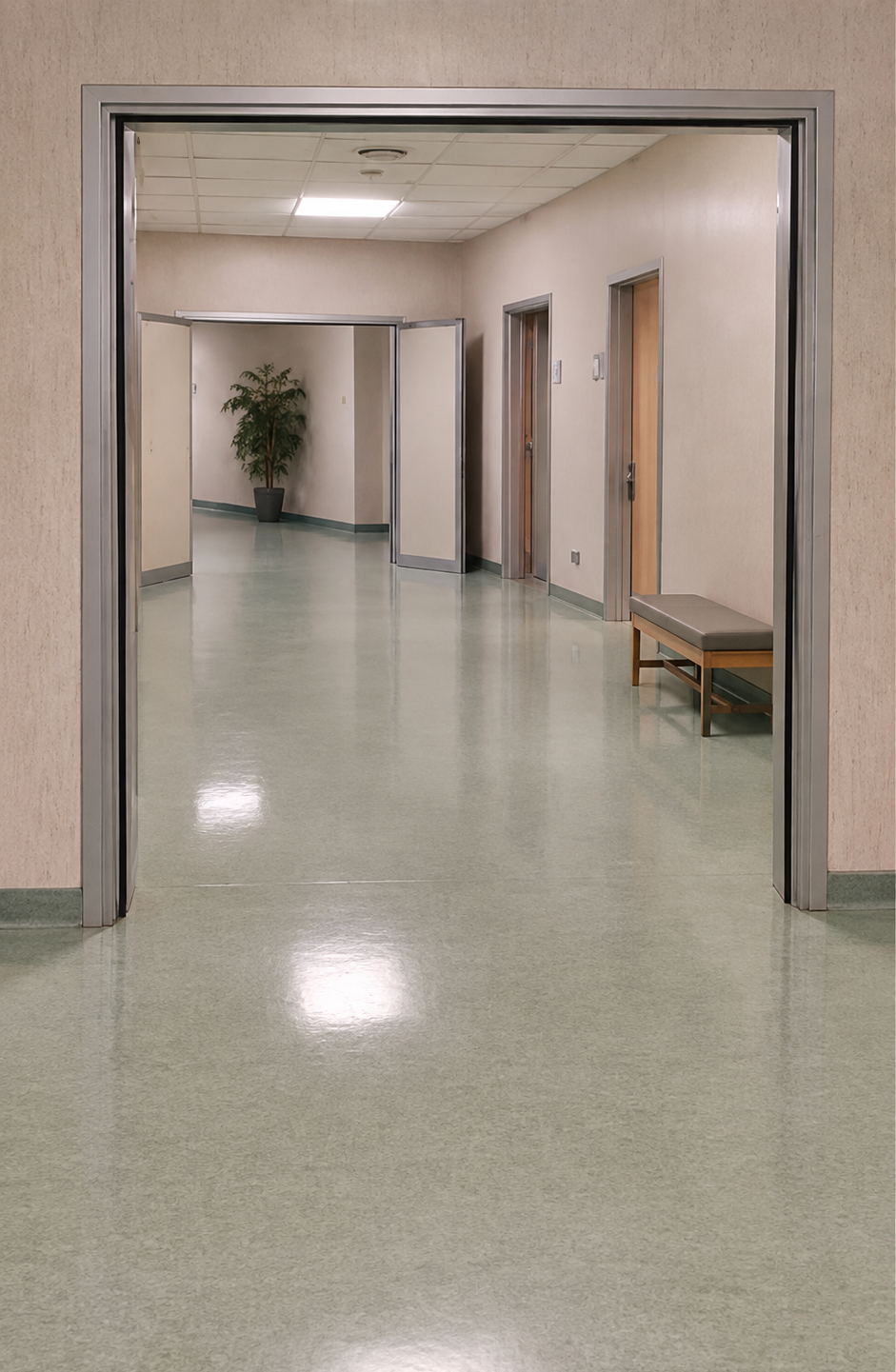
Most facility managers know the floor looks tired long before they know why. These are the conditions that mean cleaning has stopped being the answer.
Old acrylic finish ambers as it ages, and dirt caught between coats reads as a dull grey haze. Neither of them mops out, because the problem is under the surface rather than on it.
Finish collects along baseboards, in corners, and under furniture where the machine never reaches. You can usually see the ridge line where the buildup stops and the traffic lane begins.
Main walkways, doorways, and the path between a counter and a back room wear down first. When the lane is visibly darker than the floor either side of it, the finish there is largely gone.
A floor that goes dull again as soon as it dries has run out of finish for a mop or a burnisher to work with. More cleaning will not bring gloss back at that point.
Once the finish wears through, the tile itself starts taking the abrasion and the staining. That is the point where the job stops being cosmetic and starts protecting the floor you own.
White powder along the edges, coats lifting in sheets, or streaks that reappear after every mopping usually trace back to a previous job that was not rinsed and neutralized properly.
If you are seeing two or more of these, the floor is past what a mop can fix. A walkthrough will tell you whether it needs a full strip or an interim recoat.
The stages below are the order the work actually runs in. Tasks are performed according to the approved scope, so your project may include every stage here or a focused subset, decided at the walkthrough.
The setup decides how the rest of the job goes. We identify the floor material, judge how many layers of old finish are on it, measure the area, and agree what gets moved and what stays. Everything that is not being stripped is protected before any solution is opened.
Carpet extraction, hardwood and gym floor refinishing, and specialty stone polishing are quoted separately from a strip and wax rather than assumed inside it.
Three different jobs that all end with a shinier floor. Booking the wrong one either wastes money or locks a problem in, so this is the first thing we work out on site.
Every coat of old finish is removed down to the tile, the floor is neutralized, and fresh sealer and finish are built back up.
The top layers are machine-scrubbed off and one or two fresh coats go back on, leaving the sound base coats in place.
High-speed pad work that lifts gloss on an existing burnishable finish. It restores shine but adds no new protection.
A floor kept on interim scrub and recoat work needs a full strip far less often than one that is left until it fails. Floor care sits naturally inside a commercial cleaning plan, where the daily dust mopping and damp mopping is actually protecting the finish rather than working against it.
Floor finish belongs on some surfaces and does real damage on others. Identifying the material correctly is the first thing that happens at a walkthrough, because the stripping method, the dilution, and the coat count all follow from it.
The classic strip and wax floor and still the most common one we work on across Seattle schools, clinics, offices, and back-of-house areas.
Sheet vinyl in corridors, restrooms, and service areas takes finish well and benefits from the protection in wet-weather months.
Genuine linoleum needs a gentler stripping approach and pH care, so it is identified at the walkthrough rather than assumed to be vinyl.
Sealed concrete in warehouses, workshops, and back-of-house areas can be stripped and refinished where the existing sealer allows it.
Terrazzo in older schools and civic buildings can carry a maintainable finish. Condition and the existing coating decide the approach.
Hard tile floors that have been kept under a maintainable finish are stripped and recoated as part of the same programme.
Floor plans, traffic, and available windows differ enough between these that the scope and schedule are always written per building.
Classrooms, corridors, cafeterias, and multipurpose rooms, worked through summer break, winter break, or mid-year closures.
Lobbies, break rooms, corridors, and back-of-house areas where the floor is the first thing a visitor reads about the building.
Waiting rooms, treatment corridors, and staff areas where a clean, sealed floor is part of how the practice presents itself.
Sales floors, aisles, and entry zones that take constant foot traffic and Seattle weather straight off the sidewalk.
Break rooms, offices, and sealed traffic areas inside larger facilities, scheduled around shifts and equipment movement.
Fellowship halls, classrooms, and shared spaces where the floor gets heavy weekend use and quiet weekdays to work in.
Church cleaning services in SeattleLocker rooms, corridors, and hard-floor areas around the court. Hardwood playing surfaces are handled as separate refinishing work.
Lobbies, laundry rooms, corridors, and shared spaces across a portfolio, coordinated so tenants are given notice before the work.
Strip and wax is the most disruptive service in commercial cleaning, and almost all of the disruption is dry time rather than labour. The floor has to be fully dry after neutralizing, and every coat has to dry before the next one goes down, which is why the window matters more than the crew size.
The most common arrangement. The crew starts once the building empties and the floor is back in service before the first shift arrives.
A Friday-night-to-Sunday window gives finish coats proper dry and cure time before Monday, which is why larger areas usually run on a weekend.
Summer, winter, and mid-year breaks are the natural window for classrooms and corridors, and they book up early in the Seattle area.
Buildings that cannot close work section by section, so one area is out of service at a time and the rest of the operation keeps running.
Locally owned and family-operated, not a franchise with a Seattle phone number.
Square footage, floor type, how many layers of old finish are on it, and how much edge and furniture work is involved. All of it measured before a number is given, not estimated over the phone.
The rinse and neutralize step is invisible on the day and decides whether the finish is still sound in six months. It is written into the scope rather than treated as optional.
Nights, weekends, school breaks, and phased zones. The point of after-hours floor work is that your people walk in to a finished floor rather than around a closed-off one.
Sending the same crew means they learn your floor plan, your access and alarm routine, and which rooms cannot be out of service on a given day.
Scrub and recoat, burnishing, and a realistic strip cycle, so the floor is maintained on a schedule instead of being rescued once it has already failed.
Joshua Alexander runs the company and answers for it. A changed window, an added room, or a floor that needs a second look gets sorted in one conversation.
From the first call to a finished floor and a maintenance plan. Scope, coat count, window, and cost are all settled in writing before anyone opens a container of stripper.
Floor type if you know it, roughly how large the area is, when it was last stripped, and when the building can be handed over.
We measure, identify the material, judge how much old finish is on it, and look at edges, furniture, thresholds, and access.
Areas included, coat count, what gets moved, the work window, expected return-to-service timing, and what it costs. In writing.
Protect, strip, rinse, neutralize, dry, seal where needed, coat, and reset. Worked in the agreed window, in that order.
We walk the finished floor with you, hand over care guidance, and agree when scrub and recoat or the next strip should be scheduled.
Commercial floor stripping and waxing is quoted per building rather than from a published rate, because two floors of the same size can be very different jobs. A room stripped last year and a room carrying eight years of finish take completely different amounts of work to bring back.
The walkthrough turns the factors on the right into a written scope and a number, with no obligation attached. If a scrub and recoat would get you most of the result for a fraction of the cost, that is what we will quote.
Every photo below is from a real job. Restored hard floors are the clearest read available on the standard your building would be held to, so it is worth looking before you book anyone.
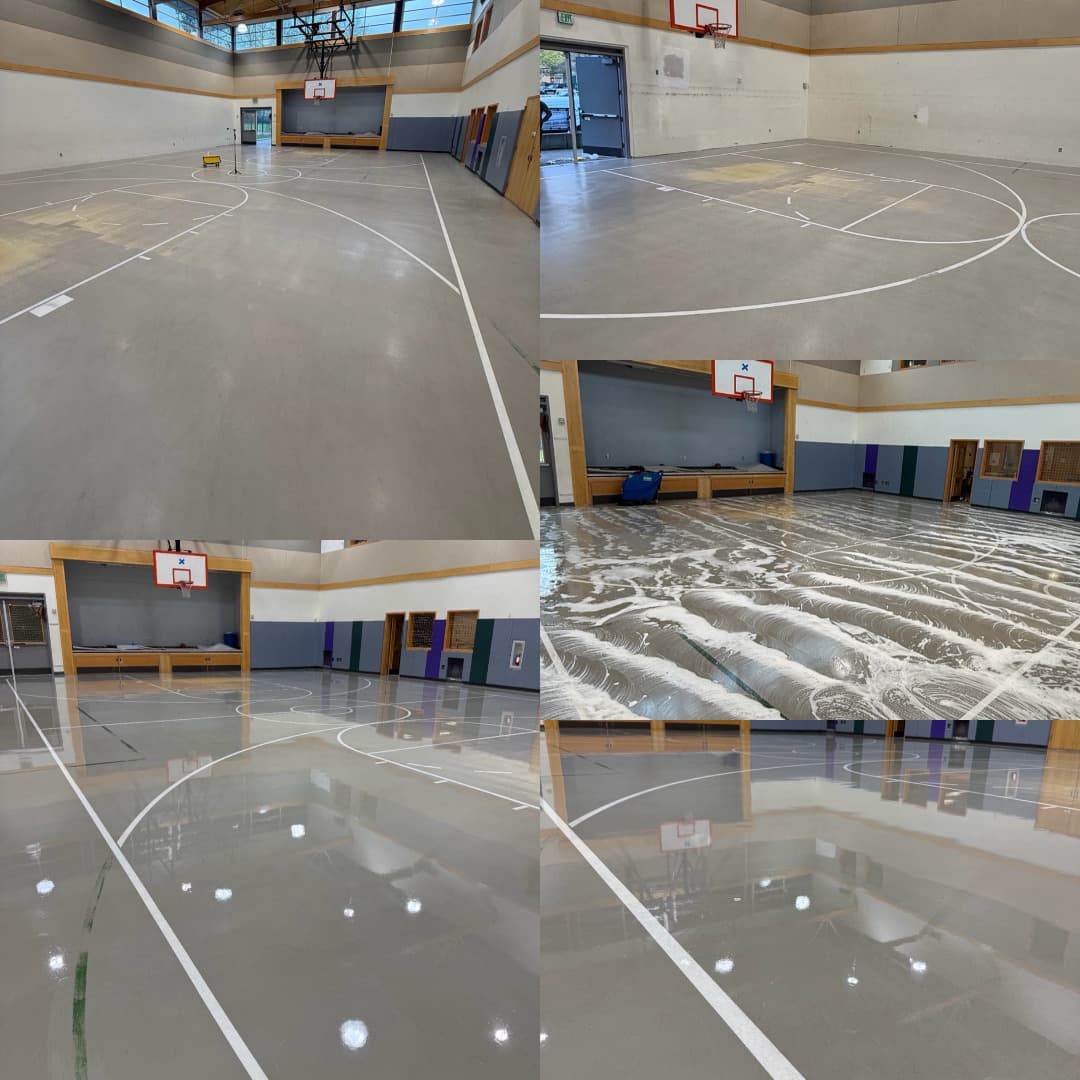
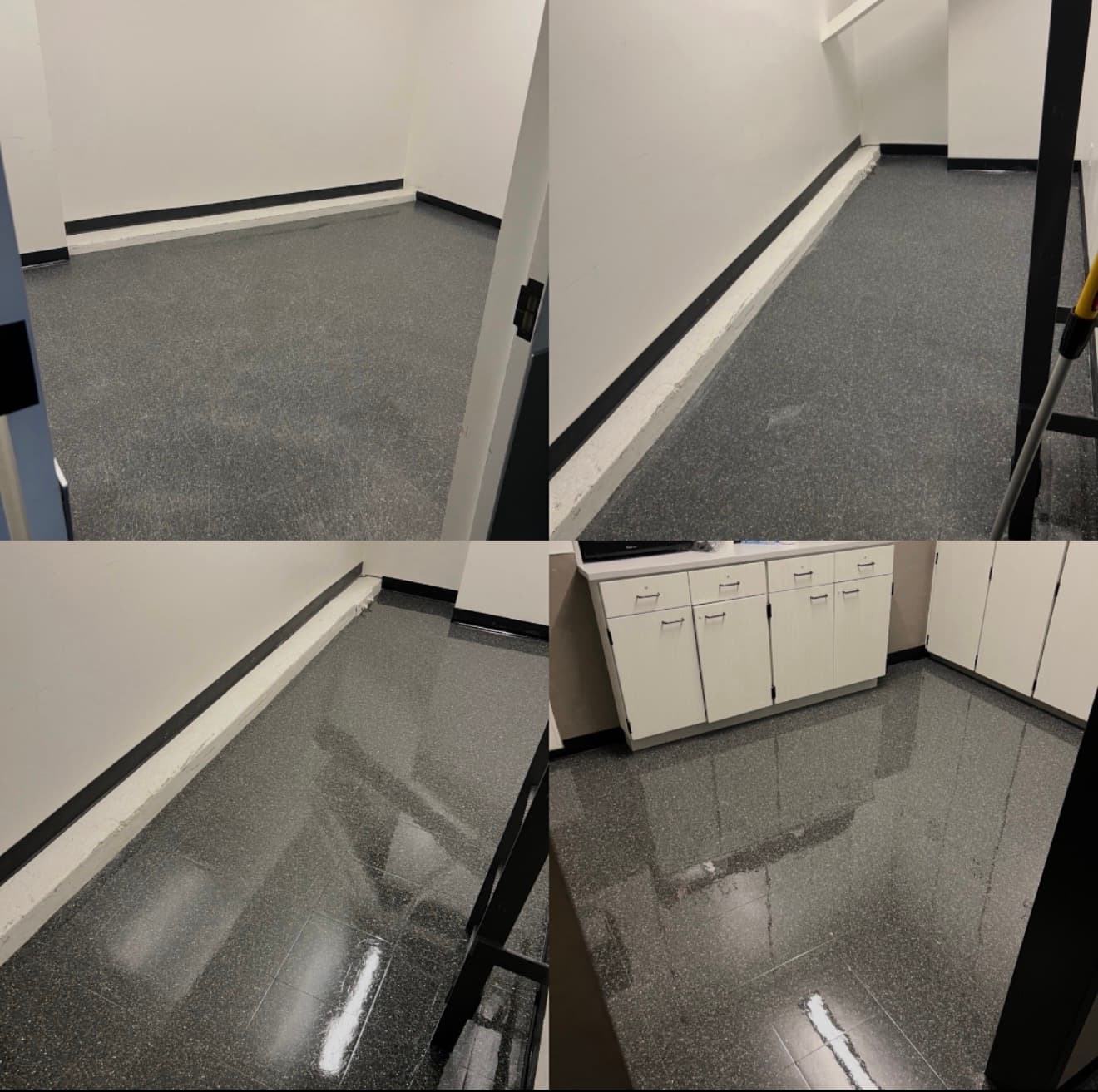
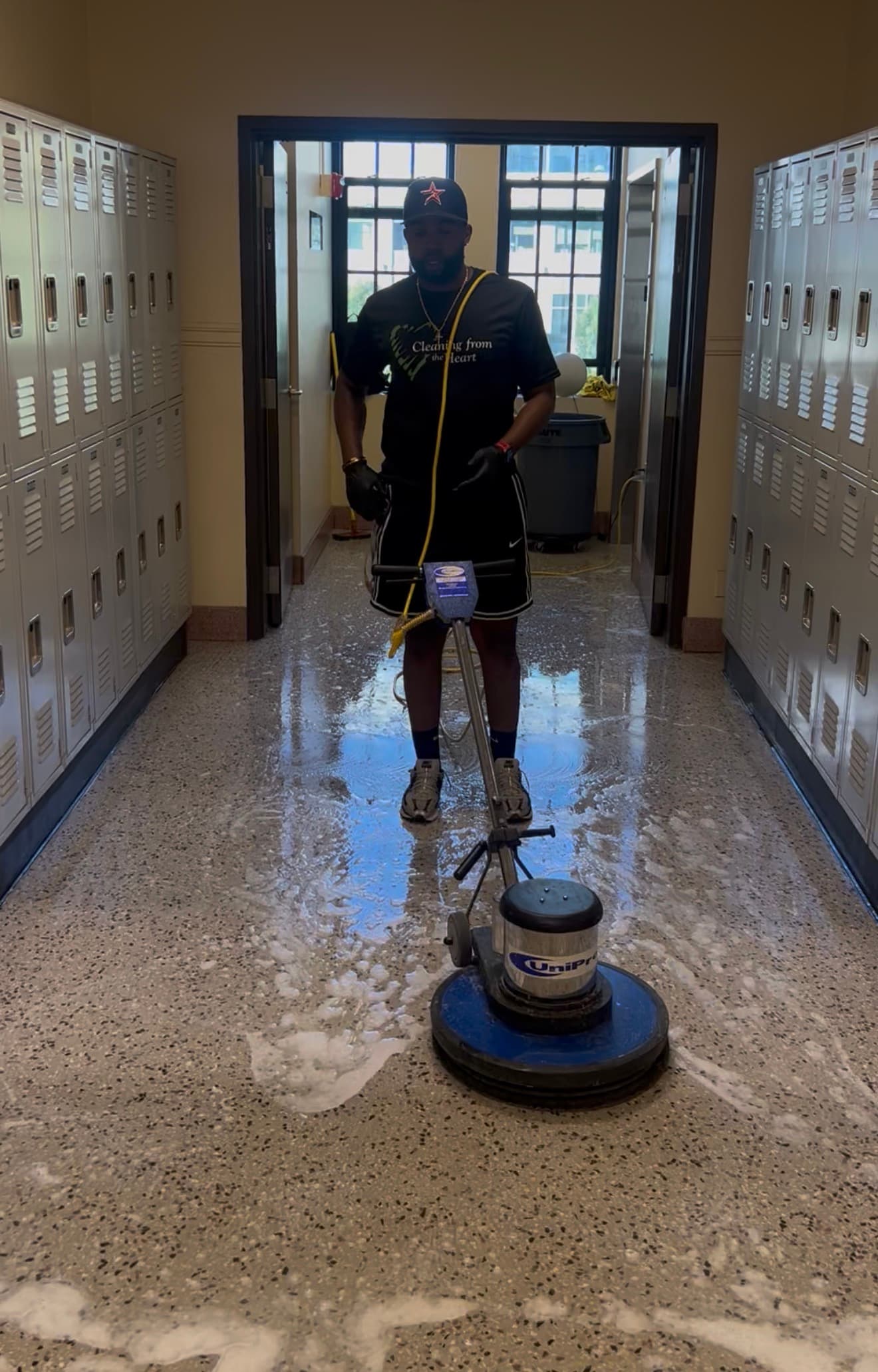
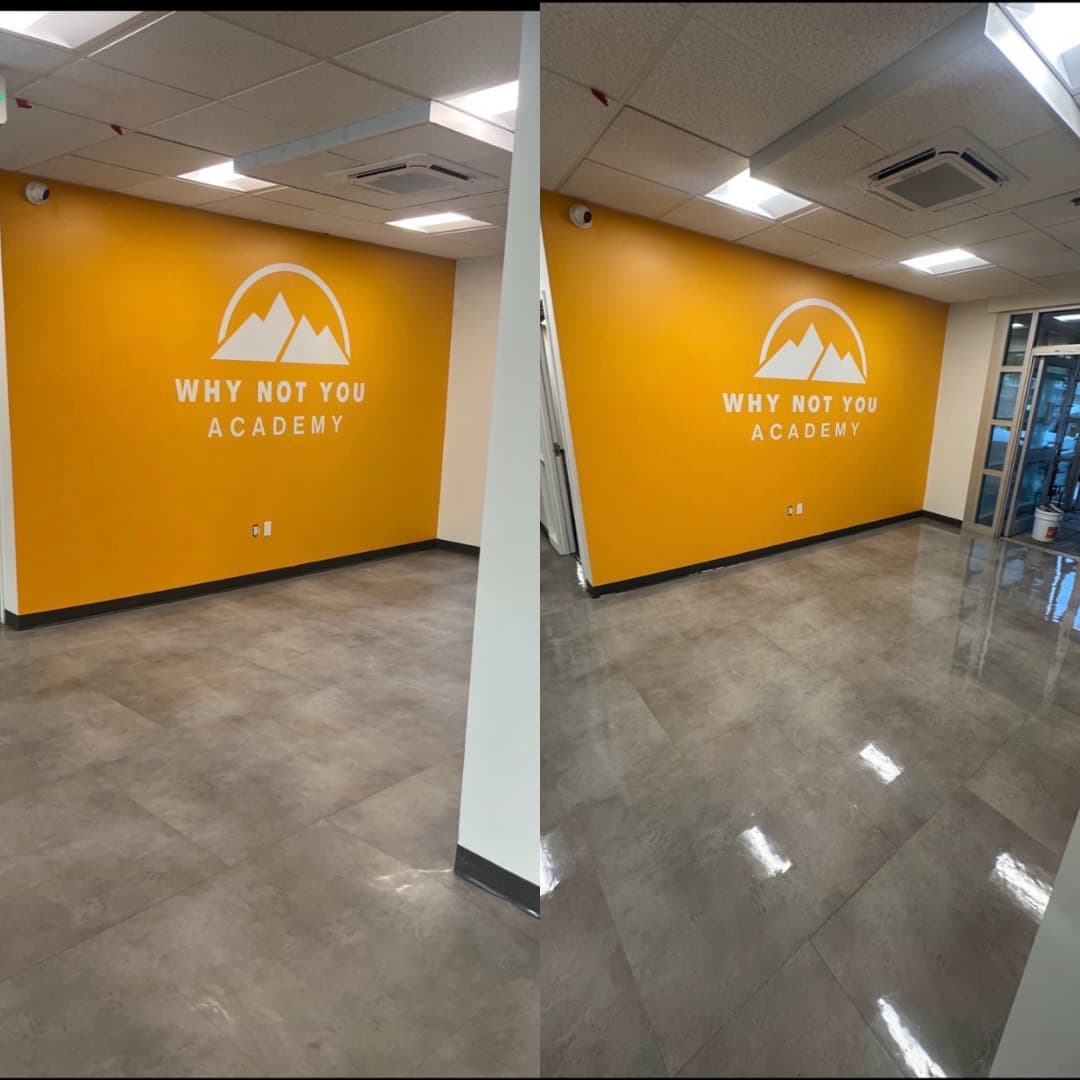
We provide strip and wax floor services throughout Seattle and the greater Puget Sound region. Because the work runs in tight after-hours windows, availability depends on the schedule as much as the distance, so it is worth a call to confirm we can commit to the window your building needs.
Serving Seattle, Renton, Bellevue, Kent, Everett & Surrounding Areas
What facility managers and building owners ask us most before booking commercial floor restoration.
Not sure what your floor needs?
Send us a photo and rough square footage and we'll tell you plainly whether it is a full strip or a recoat.
Strip and wax is a full reset of a hard floor's protective coating. The old layers of floor finish are dissolved with a stripping solution, agitated off with a floor machine and by hand at the edges, and removed as slurry. The floor is then rinsed, pH-neutralized so the new product can bond, and dried completely. Sealer is applied where the floor is porous, and several thin coats of commercial floor finish are built up with drying time between each one. The result is a bright, uniform surface with a sacrificial protective layer that takes the wear instead of the tile.
A strip and wax removes every coat of old finish and rebuilds the floor from bare tile. A scrub and recoat machine-scrubs off only the worn top layers and adds one or two fresh coats over the sound base underneath. Scrub and recoat is faster, cheaper, and less disruptive, and it is the right choice when the floor is dull or scuffed but the finish base is still good. Once the floor has yellowed, built up heavily at the edges, or worn through to bare tile in the walkways, recoating just seals that condition in, and a full strip is the honest answer.
Most commercial floors in the Seattle area are stripped and waxed about once a year, with scrub and recoat work two to four times in between. High-traffic buildings such as schools, clinics, and busy retail may need it more often, while a low-traffic office can go longer. Traffic volume, entry-mat coverage, wet weather, and how consistently the floor is dust mopped and damp mopped matter more than the calendar. The most reliable approach is a scheduled maintenance programme, so the strip happens because the floor is due rather than because it has already failed.
The wet work on a typical room or corridor runs a few hours, and larger areas are split into zones or scheduled across a weekend. Timing is driven by dry time as much as labour: the floor has to be fully dry after neutralizing, and every finish coat has to dry before the next goes on. Light foot traffic can usually return once the last coat has dried, but the finish keeps hardening for a good while after that. Mats, rolling loads, and heavy furniture wait longer. We confirm the exact return-to-service timing on site, because floor type, coat count, temperature, and airflow all change it.
VCT (vinyl composition tile) is the most common, along with sheet vinyl, commercial vinyl, linoleum, sealed concrete, terrazzo, and hard tile floors that have been kept under a maintainable finish. Hardwood and gym floors use a screen-and-recoat refinishing process instead and are quoted separately. Laminate and many luxury vinyl planks carry a factory wear layer that manufacturers do not want coated, and unsealed natural stone and polished concrete are maintained by polishing rather than by applying floor finish. If a floor should not be waxed, we say so at the walkthrough.
Commercial floor stripping and waxing is quoted per building rather than from a published rate, because two floors of the same size can be very different jobs. The inputs are square footage and layout, floor type, how many layers of old finish are on it and what condition they are in, the number of sealer and finish coats specified, how much furniture has to be moved, how much edge and detail work the layout demands, the access and length of the work window, and whether it is one area or a phased programme across a building. The walkthrough turns those into a written scope and a number, with no obligation attached.
Yes, and for most buildings that is the only sensible way to do it. Overnight is the usual arrangement for single rooms and corridors. Larger areas typically run over a weekend, which gives the finish proper dry and cure time before Monday. Schools are usually scheduled into summer, winter, or mid-year breaks, and those windows book up early. Buildings that cannot close at all are worked zone by zone. Scheduling is confirmed according to staffing, building access, and the agreed service plan.
Furniture handling is agreed in the written scope before the job. In classrooms and offices we commonly move desks, chairs, and light furnishings, work the floor, and return them to their marked positions. Heavy, fixed, sensitive, or specialist equipment is normally left in place and worked around, or moved by your own team ahead of the work. Anything we cannot safely move is identified at the walkthrough so there are no surprises on the night.
Commercial floor finishes are formulated with slip resistance in mind, and a properly stripped, neutralized, and evenly coated floor should not behave like a hazard. What causes problems in practice is water tracked in from a Seattle winter, residue from an improper strip, or an over-flooded coat that never cured. Good entry matting, prompt attention to wet spots, and consistent daily cleaning do more for floor safety than any single product choice.
Only when the existing finish is genuinely sound. Adding coats over old, yellowed, or dirt-loaded finish locks that discoloration in permanently, and adding them over a failing base means the new coats peel with the old ones. If the base is in good shape, a scrub and recoat is the right and cheaper answer, and we will recommend it. If it is not, a full strip is the only way to get a result that lasts.
Yes, and it usually should be. Floor restoration and daily cleaning work against each other when they are split across two providers with different standards. Running both together means the daily dust mopping and damp mopping actually protects the finish, interim scrub and recoat work is scheduled before wear reaches the tile, and the full strip cycle is planned rather than reactive. It can be added to a commercial cleaning or school facility cleaning plan on one written scope.
Seattle and the greater Puget Sound area, including Renton, Bellevue, Kent, Everett, Tukwila, Shoreline, Federal Way, Kirkland, Bothell, Tacoma, and the surrounding communities. Because floor work runs in tight after-hours windows, availability depends on the schedule as much as the distance, so it is worth calling to check whether we can commit to the window your building needs.
The recurring janitorial plan that keeps a newly finished floor protected week to week.
View commercial cleaningCampus cleaning plans with floor care scheduled into summer, winter, and mid-year breaks.
See school cleaningExtraction cleaning for the carpeted areas that sit either side of your hard floors.
Explore carpet cleaningA one-time detailed reset of a whole facility, often booked alongside floor restoration.
Explore deep cleaningFinal-phase cleanup on new and renovated spaces, where floors are finished before handover.
See post-construction cleanupEntry glass and interior partitions, commonly booked with a floor project on the same visit.
View commercial window cleaningStrip & Wax in Seattle
Nothing is committed until we have walked the building, identified the floor, measured the area, and worked out whether it genuinely needs a full strip. Then you get a written scope with the coat count, the work window, the return-to-service timing, and the cost.
Serving Seattle, Renton, Bellevue, Kent, Everett & Surrounding Areas